Arc de Triomphe history: Napoleon's plan and the first stone
The history of the Arc de Triomphe began after Austerlitz, when Napoleon commissioned a monument to honour his soldiers. The foundation stone was laid on 15 August 1806. The finished arch opened under Louis-Philippe in 1836, after changes of government and several changes of architect. Napoleon died before it was completed.
The Arc stands at the upper end of the Champs-Élysées on Place Charles de Gaulle, historically Place de l’Étoile. Its position on the axis between the Louvre and La Défense is easy to grasp from the avenue. From the forecourt, the monument offers a closer view of the reliefs, inscriptions and coffered vault. The directions to the Arc de Triomphe explain how to reach that forecourt through the pedestrian passage.

Interrupted construction and changing architects
Work on the Arc de Triomphe stopped after Napoleon's fall and resumed under Louis XVIII. The earliest designs were the work of Jean-François Thérèse Chalgrin and Jean-Arnaud Raymond. When Chalgrin died in 1811, Louis-Robert Goust took over. Jean-Nicolas Huyot was involved later, and Guillaume Abel Blouet was entrusted with completing the monument in 1832.
The sequence is worth keeping in mind when looking at the arch from the Champs-Élysées. The building seen from the avenue was the result of a project carried through successive reigns. The date of the foundation stone and the date of the inauguration mark distinct events in that history.
A walk through the avenue’s history
This guided walk combines historical commentary with a route along the Champs-Élysées to the Arc.
Hand-picked tours, booked through GetYourGuide. Prices are indicative starting prices in euros (as of November 2026). Tap a tour for live availability and the current price in your currency.

A guided walk on the history of the Arc de Triomphe
The two-hour walk starts at Place de la Concorde and continues along the Champs-Élysées to the arch, with live commentary on its architecture and history. The rooftop ticket is separate.
Inauguration under Louis-Philippe
The Arc de Triomphe opened on 29 July 1836 under Louis-Philippe and was dedicated to the armies of the Revolution and the Empire. That wider dedication helps explain the change in emphasis between Napoleon's original plans after Austerlitz and the completed monument. It also gives the decoration a historical frame before a close look at the stonework.
Reliefs, friezes and names in stone
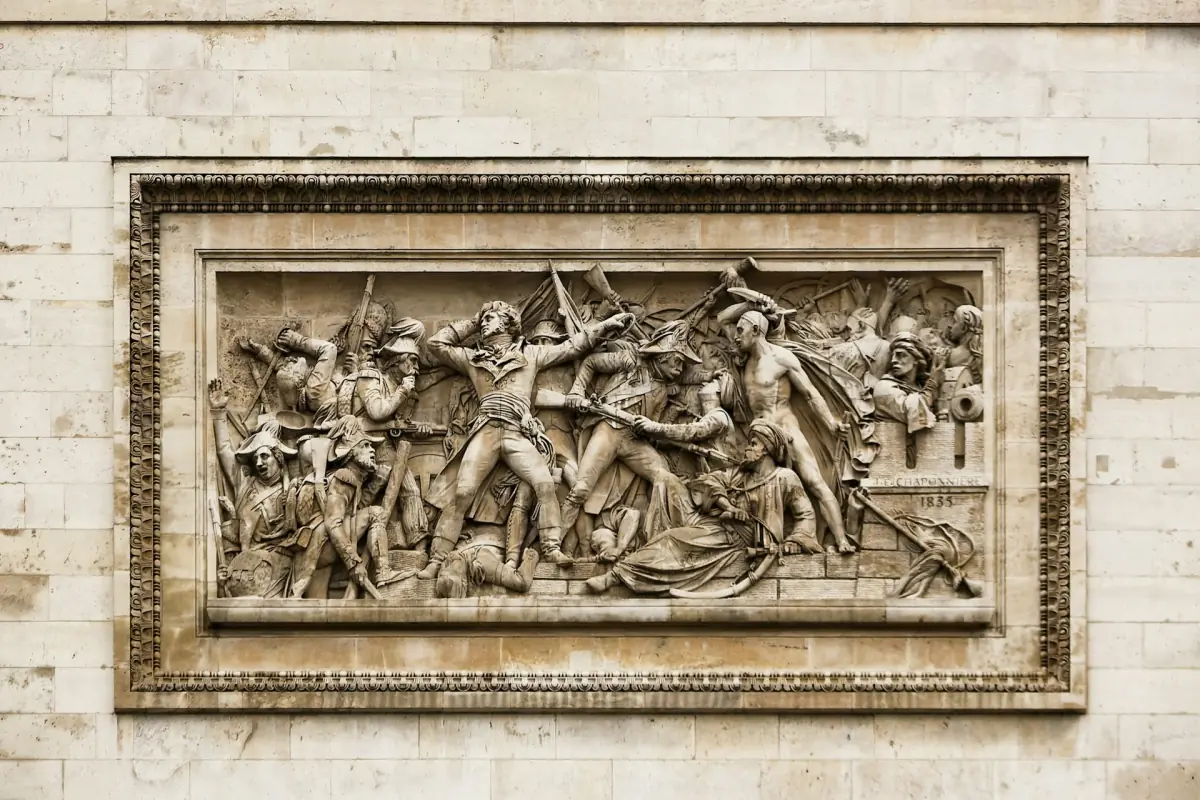
The reliefs, friezes and name inscriptions of the Arc de Triomphe are part of its programme of remembrance. Start with the raised figures on the façade, then look for the bands of carved decoration and the names cut into the stone. Looking up from beneath the arch also brings the recessed panels of the vault into view.
The Tomb of the Unknown Soldier adds a later chapter to the site. The soldier was brought to the Arc in 1920 and buried beneath it in 1921. A pause at the tomb brings the focus from the armies honoured in the monument's dedication to the grave of one unidentified soldier.
On a visit to the Arc de Triomphe, stand back when looking at the reliefs as a group, then move closer to read the names. The two views help put the individual inscriptions in the context of the monument’s dedication.
Model and cast in the museum room
The museum room inside the Arc de Triomphe has a model, a cast and interpretive screens. The model is a way to look at the monument as a whole after seeing the full-size building from the square. The cast brings a sculptural detail into the exhibition space. The museum room is part of the interior visit. The ticket guide covers access to the monument and terrace.
Questions about the history of the Arc de Triomphe
Why did Napoleon order the construction of the Arc de Triomphe?
Napoleon commissioned the Arc de Triomphe after Austerlitz to honour his soldiers. The foundation stone was laid in 1806, but construction outlasted his reign and his life. When the monument finally opened, its dedication encompassed the armies of the Revolution and the Empire.
When was the Arc de Triomphe inaugurated?
The Arc de Triomphe was inaugurated on 29 July 1836 under Louis-Philippe. The building had been interrupted after Napoleon's fall and work resumed under Louis XVIII. Guillaume Abel Blouet took charge of bringing the project to completion after an earlier succession of architects.
What can visitors see inside the Arc de Triomphe?
The Arc de Triomphe has a museum room with a model, a cast and interpretive screens. Start by looking at the façade and vault from ground level, then use the exhibition to look at the building as a whole and consider its sculpture up close.